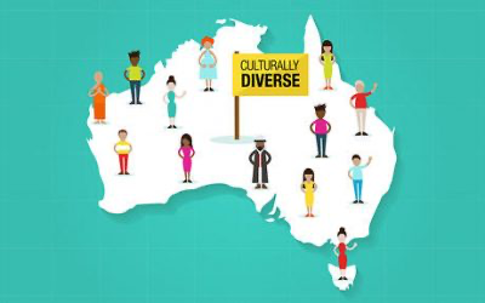
Figure. Cultural diversity in Australia. Ryan, C. (2019, April 15). SBS launches Cultural Connect: Advertising to multicultural communities. Retrieved September 22, 2024, from https://themediastore.com.au/sbs-launches-cultural-connect-advertising-to-multicultural
As an international student, I never thought I would be responsible for addressing one of Australia’s most pressing political challenges. I do not even have voting rights.
Migration is a double-edged sword for- every society. There are strategies to manage the costs while still getting the benefits, and the federal government has that—like increasing student visa application fees. Among those, however, the Australian government decided to capinternational student enrollments at 270,000 across high education by 2025. Instead of using the tools that are effective in the long term, they gave up the over $48 billion industries completely and shouted for the result desperately.
Education Minister Jason Clare has made attempts to justify the ceiling, explaining that such a ceiling is important in improving the international education system. He states that only a select few universities have raked in the benefits from the surplus of international students over the years, and the ceiling will ensure that the benefits are extended fairly across the industry. In addition, the cap is considered to be a more effective means of fighting against the ‘shonks’ – unscrupulous agents and institutions who prey on international students for money.
The ideal aims are reasonable, but the approaches remain questionable. I’m not denying the positive effects of helping remote universities attract more students, but could this cap solution solve the problem of crooked agents? Not all international students are seeking help from them, but people who want to, always find the way. There are also those who pointed out that instead of the direct cause of the lack of enough housing and processing backlog, international students’ living pressure reveals the existing problems that are fundamentally caused by supply-side factors like underinvestment and government regulation. If the government truly believes the policy can make this system ‘better and fairer’, then where is the economic benchmarking to validate this claim?
But, to be honest, the discussion in the economic sphere is not even the strongest. At first glance, the cap appears to be a response to Australia’s housing crisis and immigration concerns. Simple logic: fewer students, fewer competitors in the housing market, fewer stresses on everyone. Yet this reductive approach treats students like numbers in a ledger rather than individuals with unique stories, aspirations, and contributions.
As an international student, I see this cap as more than just an economic or political issue—it’s a personal one.
When the government chooses this easy and even arbitrary way to manage the immigration level and release the housing stresses, students are simplified as a variety in an equation. We are not just numbers on a spreadsheet or a quick fix for the nation’s visa and housing crises. Australian universities are the key to maintaining and improving the value of social justice, freedom, and fairness in everyday life. As an international student, I arrived in Australia for further study, full of hope and excitement, knowing that I would receive not just a quality education but also the opportunity to immerse myself in a vibrant, multicultural society. For many of us, coming to Australia is because of these, and trust that we can receive equal opportunities and respect. But this announcement pushes thousands of aspiring students away from the opportunities. Seeing that the government is risking solving the housing crisis by causing a negative influence on Australia’s global reputation and culture, I feel not welcome in this country.
Choosing to study in Australia is not merely an economic transaction or a pathway to migration. It is about being part of a vibrant, globally connected community where diversity fuels innovation, and cross-cultural collaboration shapes our education. Victoria’s Deputy Premier Ben Carroll posted supportive opinions that, international students are also very important for the cities – for instance, Melbourne. They are not only economic goods but rather are very important components of metropolitan cultures. By limiting the numbers, the government is not only restricting our economic potential but is also depriving Australian cities of the attributes that are appealing to students from other countries. The cap presents more of a risk than anything else. In the case of prospective students, it means there is more hunting for admission to fewer available places in the best colleges. To the existing students, it means an anxious wait to get housing, jobs, or extensions for their visas.
In addition, the human cost of being ignored should not be underestimated either. International students are not temporary visitors, they are the ambassadors from different countries, the bridge between cultures and the future leaders. Many international students come to Australia with the hope of building long-term relationships with the country, the connection is beneficial to us, and important to the country as well. These ties continue as we go back, with beautiful impressions, further influencing the next generation to learn, visit, and build careers here. This particular rhetoric fails to capture the comprehensive meaning of education: an investment in Australian global reputation, soft power, and international relations in the long term. With this in mind, we are more than the “net immigration level” that people try to balance; we are the ones who are closely connected to Australia’s future.
Instead of limiting the number of international students, Australia should address its housing crisis directly by increasing investment in student accommodation, reforming zoning laws, and incentivizing construction are all potential ways to ease housing pressures without harming the education sector. The future of Australian education depends on its competitiveness in a global market limiting international students may alleviate the housing crisis in the short term, but the long-term consequences could be catastrophic. By addressing the root causes of the housing problem, Australia can continue to attract the best talent from around the globe, ensuring the world-class status of its universities and the continued strength of its economy.
References
Aly, W. (2024, September 5). Australian students could be the real victims of international caps. The Age. https://www.theage.com.au/politics/federal/australian-students-could-be-the-real-victims-of-international-caps-20240905-p5k80e.html
Go8 statement on the National Planning Level and international student caps. (n.d.). Group of Eight. Retrieved September 22, 2024, from https://go8.edu.au/go8-statement-on-the-national-planning-level-and-international-student-caps
International student commencements to be capped at 270,000 next year. (2024, August 27). ABC News. https://www.abc.net.au/news/2024-08-27/international-student-caps-higher-education/104274056
Lin, W., & Chan, S.-J. (2024). Students as a Nexus of Cultural Diplomacy: Estimating the Outcomes of the International Higher Education Scholarship Program in Taiwan. Journal of Studies in International Education, 28(3), 420–439. https://doi.org/10.1177/10283153231178133
Media release: Capping international students will not fix housing affordability or supply. (n.d.). Group of Eight. Retrieved September 22, 2024, from https://go8.edu.au/media-release-capping-international-students-will-not-fix-housing-affordability-or-supply
Oliver Peterson, O. (2024, May 13). International student cap: Federal Government’s bid to minimize housing crisis. Retrieved September 22, 2024, from https://www.6pr.com.au/international-student-cap-federal-
Ryan, C. (2019, April 15). SBS launches Cultural Connect: Advertising to multicultural communities. Retrieved September 22, 2024, from https://themediastore.com.au/sbs-launches-cultural-connect-advertising-to-multicultural
What do we lose when we weaken our universities? The case against a cap on international students—ABC Religion & Ethics. (n.d.). Retrieved September 22, 2024, from https://www.abc.net.au/religion/luara-ferracioli-case-against-cap-international-students/104014986
Welcome to Melbourne. Retrieved September 22, 2024, from https://d2zvoup3y18efk.cloudfront.net/org_region_assets/programs/ckphotos/470774/original.jpg?1609929486
The original news article:
Aly, W. (2024, September 5). Australian students could be the real victims of international caps. The Age. https://www.theage.com.au/politics/federal/australian-students-could-be-the-real-victims-of-international-caps-20240905-p5k80e.html
Leave a Reply